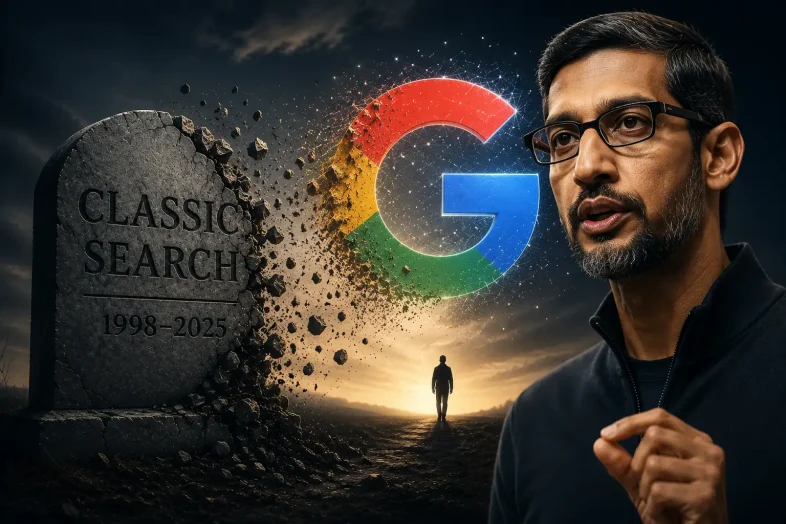
Something significant happened recently and most content creators scrolled past it.
Google’s CEO Sundar Pichai sat down for an interview and was asked a direct question: will classic search — the ten blue links we’ve all built our content strategies around — eventually go away in favor of AI Mode?
His answer was careful. Measured. And if you read between the lines, a little unsettling.
He called it a “continuum.” A gradual transition. He said users are responding positively to AI Mode based on Google’s internal metrics. He confirmed that sources and links will remain part of the experience. And when asked whether he’s comfortable with users abandoning classic search entirely, he said he feels confident that a blend of subscriptions and advertising will sustain Google’s business model going forward.
Google will be fine. The question Search Engine Journal rightly raised — and the one every content strategist should be sitting with right now — is where that leaves the rest of us.
Visibility Is Not the Same as Traffic
Here’s the part of Pichai’s answer that deserves more attention than it’s getting.
He confirmed that links and sources will remain part of AI Mode. That sounds reassuring. It isn’t — not entirely.
Because there’s a meaningful difference between being cited in an AI-generated answer and being clicked on. AI Mode can reference your content, summarize your expertise, and present your insights to a user — all without sending that user to your website. You get visibility. You don’t necessarily get the visit.
This is what’s being called Google Zero in SEO circles — the calculation that organic referral traffic from Google may eventually trend toward zero for many publishers, even as their content continues to be consumed through AI summaries. Google preserves the appearance of attribution while the economic value of a click quietly diminishes.
For content writers and strategists, this isn’t a distant hypothetical. It’s a strategic reality to start planning for now.
What This Actually Means for Content Strategy
I’ve spent seven years building content strategies for clients who depend on search visibility for business growth. Here’s my honest read of what’s shifting.
Ranking is no longer the finish line.
For years the goal was to get your content to the top of search results and let the traffic follow. That relationship between ranking and traffic is loosening. AI Mode answers questions directly — and when the answer is satisfying enough, users don’t need to click anywhere.
Being citeable matters more than being rankable.
The new question isn’t just “will Google rank this?” It’s “will Google’s AI reference this as a trustworthy source?” That requires a different kind of content — more authoritative, more specific, more demonstrably expert. Generic content doesn’t get cited. Genuine expertise does.
Your owned audience is now your most valuable asset.
If Google referrals become less reliable, the content creators and brands with direct relationships to their audiences — email lists, newsletters, loyal readers who come back without a search prompt — are sitting on something increasingly rare and valuable. Building that audience isn’t a nice-to-have anymore. It’s a hedge against a search landscape that is changing underneath everyone’s feet.
The Bigger Picture
Pichai compared AI’s impact to the introduction of the spreadsheet — a technology that changed how financial analysts worked but didn’t eliminate them. People will be more productive, he said. They’ll have more time for leisure.
It’s a reasonable analogy in isolation. But it sidesteps a specific problem: the spreadsheet didn’t answer your questions for you and then not tell you where it got the information. AI Mode does.
The web ecosystem runs on the exchange of traffic for content. Publishers create, Google sends readers, everyone benefits. AI Mode is changing that exchange — and the new terms haven’t been fully negotiated yet.
That uncertainty is real. But it also creates an opening for content creators who adapt early.
The ones who build genuine authority in a specific niche, who cultivate direct reader relationships, and who create content too specific and too credible to summarize away — they’re building something that survives whatever search becomes next.
The transition is a continuum, Pichai said.
Make sure you’re moving in it — not waiting to see where it ends.