
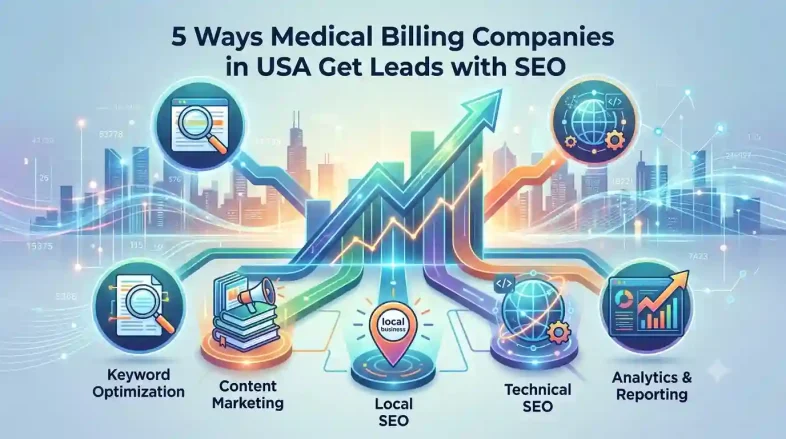
Most medical billing companies in the USA have a website. Very few have a website that actually generates leads.
The gap between the two is almost always the same thing: content that exists to fill space rather than content that answers the specific questions a practice manager or physician is searching for at the exact moment they need a billing partner.
Medical billing companies in the USA operate in one of the most trust-sensitive B2B markets in the country. Clinics, hospitals, and specialty practices are not making quick decisions. They are choosing a partner to handle their revenue, their compliance, and their financial stability. That decision starts online, almost always with a search engine, and the company that shows up with the most specific, credible, useful answer wins the conversation before it even begins.
Here is how to be that company.
1. Fix Your Content Before You Build More of It
This is the part most medical billing companies skip, and it is the most expensive mistake in the entire SEO playbook.
An analysis of 50 medical billing companies found that every single one failed Google’s E-E-A-T standards. Common content problems included low quality blog posts that visitors immediately abandoned, irrelevant topics that failed to address prospect pain points, and outdated content strategies not aligned with search intent. What genuinely useful content actually looks like in practice?
That finding is worth sitting with. Companies with thousands of backlinks and years of publishing history are generating virtually zero leads from their content, not because they did not try, but because they built volume before building quality.
Before adding new content, audit what you already have. Find the pages that exist but have no traffic, no engagement, and no clear connection to what a practice manager actually searches for when they are looking for a billing partner. Those pages are not neutral. They are actively signaling to Google that your site does not demonstrate genuine expertise in the area it claims to serve.
Fix what exists before creating what is new. A smaller number of deeply useful, accurate, specific pages consistently outperforms a large library of thin, generic content in medical billing SEO.
2. Target the Keywords Your Actual Buyers Are Searching
Generic SEO for medical billing companies in the USA fails because it targets the wrong search intent.
Clinics, hospitals, and specialty practices now rely heavily on search engines when choosing revenue cycle partners. Unlike outbound outreach, SEO brings decision-makers who are already looking for solutions such as claim denial reduction, credentialing support, coding accuracy, or full revenue cycle management. Softtrix
That distinction matters enormously for keyword strategy. A practice administrator searching “medical billing services” is browsing. A practice administrator searching “how to reduce claim denial rate for cardiology practice” is in active pain and looking for a specific solution. The second search is worth ten times more than the first in terms of lead quality.
Build your keyword strategy around the problems your buyers are trying to solve, not around the services you want to sell. Map content to three stages of the decision process: early stage research where they are learning about their problem, mid stage comparison where they are evaluating solutions, and late stage intent where they are ready to choose a partner.
Specialty specific keywords consistently outperform generic ones in both ranking difficulty and lead quality. “Medical billing for cardiology practices” attracts a more qualified prospect than “medical billing services” and faces significantly less competition from larger, better resourced competitors.
3. Build Specialty Service Pages That Demonstrate Real Knowledge
One of the biggest mistakes medical billing companies make is trying to serve everyone. You instantly look generic. Instead, specializing makes your messaging more specific, your SEO improves dramatically, your ads convert higher, and your authority increases. Markobrando
A generic services page that describes your billing company in broad terms serves nobody well. A practice manager for a dermatology clinic does not see themselves in a page that talks about “comprehensive billing solutions for healthcare providers.” They see themselves in a page that addresses the specific coding challenges, denial patterns, and payer requirements that are unique to dermatology billing.
Build a dedicated page for every specialty you serve. Each page should demonstrate real, specific knowledge of that specialty’s coding environment, common denial reasons, compliance considerations, and revenue cycle challenges. Not as a list of features, but as a demonstration of understanding that makes a prospect think “these people actually know my world.”
This approach does three things simultaneously. It signals genuine expertise to Google’s E-E-A-T evaluation. It ranks for specialty specific search terms your competitors are not targeting. And it converts at a significantly higher rate than generic service pages because it speaks directly to a specific reader’s specific situation.
4. Use Content to Build Trust Before You Ask for Business
Medical billing SEO fails when content is created only for ranking and not for conversion. A structured content system ensures every article supports lead generation. Without this structure, traffic remains informational and rarely converts into clients.
The content that generates leads in the medical billing space is not content that promotes your company. It is content that demonstrates that your company understands the problems your prospects are dealing with at a level that earns their trust before they ever speak to you.
This means writing about claim denial management with enough specificity that a billing manager learns something useful. It means addressing compliance questions that keep practice owners awake at night. It means publishing content about specialty specific coding challenges that positions your company as an authoritative resource, not just another vendor claiming expertise.
SEO for healthcare companies brings an average of $1.9 million per year in new net revenue according to First Page Sage, and that performance stems from a content approach built specifically around thought leadership and educational content mapped to high intent transactional keywords. SeaRanks
The formula is consistent across the industry: educate first, sell second. The medical billing companies generating consistent inbound leads through content are the ones that built genuine authority over time, not the ones that published the highest volume of promotional material.
5. Convert the Traffic You Already Have
Getting traffic is half the equation. Converting that traffic into actual inquiries is where most medical billing companies in the USA lose the return on their SEO investment.
Even strong content fails if the conversion path is weak. Technical performance directly impacts conversion rates, and even a 2 to 3 second delay can reduce inquiry submissions significantly. Softtrix
Beyond technical performance, the conversion path on most medical billing websites is vague. A generic “contact us” form at the bottom of a services page does not give a prospect enough of a reason to take action. They need a specific, low commitment next step that feels safe for a high trust decision.
A free AR performance review, a denial rate analysis, or a no obligation revenue cycle assessment gives a prospect something concrete to say yes to before they are ready to commit to a partnership. The offer should connect directly to the pain point the page addresses. A page about claim denial management should offer a denial analysis. A page about specialty billing should offer a free coding review for that specialty.
Match the offer to the pain. Make the next step specific and low risk. And make sure the page loads fast, works on mobile, and does not make a busy practice manager work to find out how to get in touch.
The Bottom Line
Medical billing companies in the USA that generate consistent leads through SEO share one characteristic: they treat their online presence as a trust building system, not a promotional channel.
They write content that demonstrates real knowledge of the industries they serve. They target the specific searches that reflect active buying intent. They build specialty pages that speak to one reader’s specific situation rather than everyone’s general situation. And they make it easy for a qualified prospect to take a low risk next step before they are ready to make a full commitment.
The medical billing market is competitive. The content most companies are publishing is not. That gap is the opportunity, and it is available to any company willing to build content that actually serves the people searching for it.