There are two kinds of LinkedIn content.
The kind that builds a following. And the kind that builds a business.
Most people publishing on LinkedIn are trying to do both and accidentally doing neither. They are producing content that is polished enough to look professional but not specific enough to attract the exact people who would ever pay for what they do. They are getting likes from peers, encouragement from connections, and occasional viral moments that feel significant and produce almost nothing in terms of real opportunity.
A LinkedIn content strategy is not about posting consistently and watching the audience grow. It is about deciding, before you write a single word, what you want your content to do and for whom. That decision determines everything that follows — the topics you choose, the way you frame your expertise, the calls to action you use, and the gap between the followers you accumulate and the clients or opportunities you actually convert.
Why Most LinkedIn Content Strategies Produce Followers Without Business
The most common LinkedIn content strategy is not really a strategy at all. It is a content calendar dressed up as one.
Post consistently. Use a strong hook. Add line breaks. End with a question. Respond to comments within the first hour. Repeat.
All of that is useful at the tactical level. None of it addresses the strategic question underneath it, which is: what does this content need to communicate to the specific person who could become a client, a hiring manager, a collaborator, or a genuine opportunity?
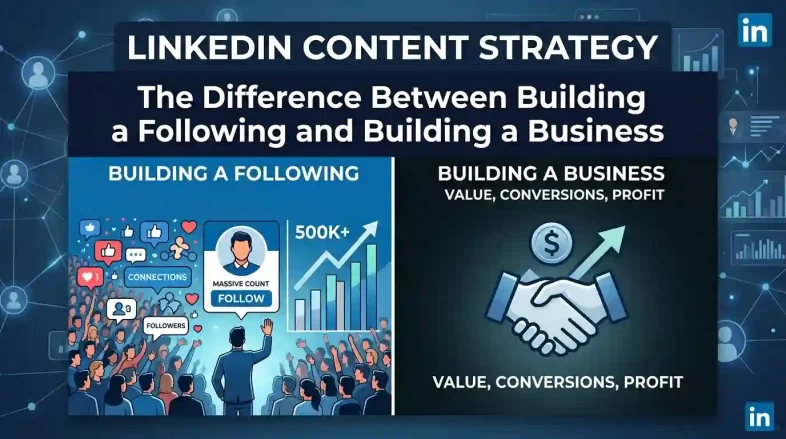
Content that builds a following is optimized for reach. It is broad enough to be relatable to many people, specific enough to be interesting, and structured to encourage engagement from a large and loosely defined audience. It performs well by platform metrics. It rarely converts into anything tangible because it was never built around a specific person’s specific decision.
Content that builds a business is optimized for the right people rather than the most people. It demonstrates a specific kind of expertise to a specific kind of reader who has a specific problem. It may reach fewer people overall. The people it does reach understand exactly what you do, whether it is relevant to them, and what the logical next step is.
The gap between these two types of content is not a creative gap. It is a strategic one. And it explains why professionals with thousands of followers can spend months posting consistently and generate almost no business from it.
As I explored in How to Become a LinkedIn Influencer: The Unwritten Rules, the performance layer of LinkedIn rewards breadth. The business layer rewards specificity. You cannot optimize for both simultaneously without deciding which one matters more right now.
The Three Types of LinkedIn Content and What Each One Does
A functional LinkedIn content strategy is not built around one type of content. It is built around three, used deliberately for different purposes.
Credibility Content
Credibility content demonstrates that you know what you are talking about. It shows your thinking, your process, your framework, your specific experience with a specific kind of problem. It does not try to reach everyone. It tries to convince the right people that you are genuinely qualified to help them.
This is the content that converts. Not immediately, and not always directly. But the reader who encounters your credibility content and thinks “this person actually understands my situation” is the reader who reaches out three weeks later when the problem becomes urgent enough to act on.
Credibility content looks like: a specific observation from your own work that challenges a common assumption in your field. A process you use that produces a result most people do not get. A mistake you made that cost something real and what it taught you. The kind of content that could only have been written by someone who has actually done the work.
Relatability Content
Relatability content builds the human connection that makes credibility content believable. It is the content that lets people see beyond the professional position to the person behind it. The honest moment from a real week. The doubt that surfaced during an otherwise confident period. The experience of being wrong about something you were certain about.
Relatability content does not convert on its own. But it does something credibility content cannot do in isolation: it makes the reader trust that the expertise they are seeing is real and human rather than performed and rehearsed.
The satire pieces I have published, like A Brief, Honest Guide to LinkedIn Thought Leadership, serve a relatability function. They signal that the person writing them sees the platform clearly, does not take themselves too seriously, and is willing to say the true thing even when it is slightly uncomfortable. That signal builds more trust with some readers than a dozen credibility posts ever would.
Visibility Content
Visibility content is optimized for reach rather than depth. It is broader, more relatable to a general professional audience, and structured to travel through networks rather than land with a specific reader. It is the content that gets shared by people who do not follow you, reaches new audiences, and builds the top of the funnel.
Visibility content does not convert well on its own. But without it, credibility content only ever reaches the people already following you, and the audience never grows beyond its current size.
The mistake most LinkedIn content strategies make is publishing too much visibility content and too little credibility content. The metrics on visibility content feel good because reach is high. The business results are poor because the content was never built to convert the right reader into the next conversation.
What a LinkedIn Content Strategy Actually Looks Like in Practice
A functional LinkedIn content strategy answers four questions before a single post is written.
Who specifically is the one person this content is for?
Not a demographic. Not a job title. A specific kind of person with a specific situation. A marketing manager at a 30-person B2B company who has been producing content for a year and cannot explain why it is not generating leads. A practice administrator at a specialty clinic who is seeing their denial rate climb and does not know where the problem is starting. A founder who has been posting on LinkedIn for six months and getting encouraging responses but no business.
The more specifically you can describe that person before you write, the more directly your content will speak to them when they encounter it.
What does this specific person need to believe before they would take the next step with me?
This is the most important question in any LinkedIn content strategy and the one almost nobody asks. Every piece of content you publish should be moving the right reader closer to a belief that makes them more likely to reach out, more likely to trust, more likely to see the obvious next step.
If the belief you need them to hold is “this person understands my specific industry,” your content needs to demonstrate that understanding specifically. If the belief is “this person has solved problems like mine before,” your content needs to show that experience in concrete, specific terms. Generic content cannot move anyone toward a specific belief because it was never aimed at one.
What is the ratio of credibility to visibility content?
A content strategy that is 80 percent visibility and 20 percent credibility builds a following. One that is 60 percent credibility and 40 percent visibility builds a business and a following simultaneously, more slowly but more durably.
The right ratio depends on where you are in the lifecycle of your LinkedIn presence. Earlier stages benefit from more visibility content to build the audience. Later stages should shift the ratio toward credibility content to convert that audience into something real.
What is the next step after someone reads this?
Every piece of credibility content should have a natural next step visible somewhere nearby. Not a hard sell appended to every post. But a services page linked in the bio. A newsletter someone can subscribe to. A way for the right reader to take the logical next action after being convinced that you are worth paying attention to.
Content without a next step is a conversation that ends at the most interesting moment. The reader is convinced. They have nowhere to go. The opportunity disappears without either side knowing it happened.
The Content That Actually Converts on LinkedIn
The posts that produce real business from LinkedIn share characteristics that have nothing to do with reach or engagement metrics.
They are specific enough to exclude most readers and attract the right ones. They demonstrate expertise through a concrete example rather than claiming it through a general statement. They name a problem the reader is already experiencing in language that makes the reader feel understood rather than marketed to. And they make it obvious, without being promotional, that the person writing them knows how to solve that problem.
As I wrote in What Makes a LinkedIn Post Go Viral Has Nothing to Do With the Algorithm, the content that travels is the content where a specific reader feels like it was written for them. The same principle applies to content that converts. The reader who feels genuinely understood does not need a sales pitch. They already know the next step.
This is why building a personal brand on LinkedIn is not about follower counts or engagement rates. It is about the accumulated impression you create in the mind of the specific person who would ever hire you, work with you, or refer you to someone who needs what you do. That impression is built post by post, over a longer timeline than most people sustain, from content that is specific enough to mean something to the right person rather than something to everyone.
The LinkedIn Content Strategy Most People Never Build
The most effective LinkedIn content strategy is not complicated. It is just difficult to maintain because it requires resisting the pull toward content that performs well by platform metrics but produces nothing in terms of real opportunity.
It requires publishing credibility content consistently even when visibility content would get more likes. It requires being specific enough to exclude people who are not the right fit even when broad content would reach more people. It requires trusting that the right ten readers matter more than a thousand wrong ones and acting on that belief every time you sit down to write.
The following is a byproduct of the strategy. The business is the point of it.
Build the content for the business first. The following takes care of itself.