
There is a story in Napoleon Hill’s Think and Grow Rich that has stayed with me longer than almost anything else I have read about persistence.
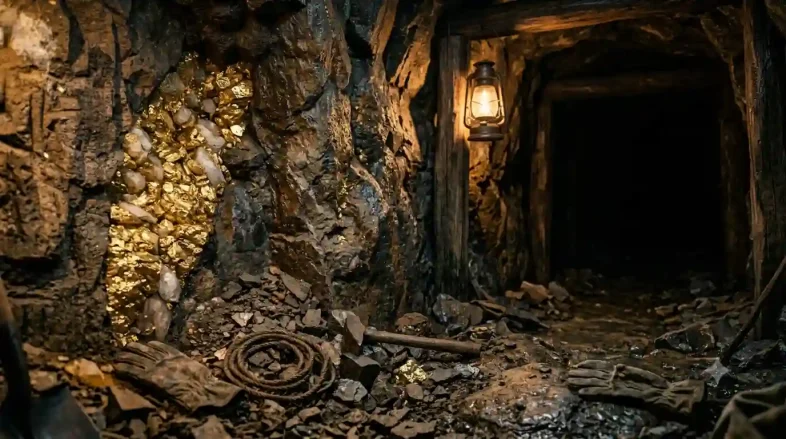
A man named R.U. Darby travels to Colorado during the gold rush, stakes a claim, and starts digging. He finds gold, raises money from relatives, brings in machinery, and gets to work. For a while, the gold flows. Then it stops. The vein disappears. After weeks of drilling and finding nothing, Darby gives up, sells the machinery to a junk dealer for a few hundred dollars, and goes home.
The junk dealer hires a mining engineer, who studies the geology of the land and concludes that the gold vein had simply shifted. He starts drilling three feet from where Darby stopped.
He strikes gold immediately.
Darby was three feet from a fortune when he quit.
Hill tells this story as a lesson about persistence. But the part that actually stays with me is not the gold. It is the question underneath the story: how do you know, when you are deep in the difficult part of something, whether you are three feet from the breakthrough or genuinely working a depleted vein?
That question is the real one. And why people give up too soon is almost never about weakness. It is about not having a way to answer it.
Why People Give Up Too Soon: The Real Reason
Most conversations about quitting frame it as a character failure. The person lacked grit, discipline, resilience. If they had just pushed harder, they would have made it.
This framing is both unhelpful and largely inaccurate.
The people who give up too soon are not, in most cases, people who lack determination. They are people who ran out of evidence that continuing made sense. The effort was real. The sacrifice was real. The invisible return was real too, accumulating somewhere beneath the surface where nobody could see it, including the person doing the work.
What they lacked was not will. It was a way to distinguish between two situations that feel completely identical from the inside.
The first situation is genuine exhaustion of the vein. The approach is wrong, the direction is off, the strategy has a fundamental flaw that more effort will not fix. In this case, stopping is not giving up. It is intelligent reallocation of energy toward something that has a better chance of working.
The second situation is the flat part of the curve, where the work is accumulating invisibly and the breakthrough is genuinely close, but nothing on the surface indicates that. This is where Darby was. This is where most people quit.
From the inside, both feel exactly like failure. Both produce the same exhaustion, the same quiet voice suggesting that maybe this was never going to work. The difference between the person who breaks through and the person who sells the machinery for a few hundred dollars is rarely talent or even effort.
It is usually just the ability to stay long enough to find out which situation they were actually in.
The Evidence Question
Here is the most useful thing I have found for navigating this distinction.
Before deciding to quit, ask for evidence rather than feelings.
Feelings are unreliable at this stage. When you are deep in the difficult part of something, feelings say it is never going to work. They have said that to every person who eventually broke through, and they were wrong every time. Feelings are not data. They are a response to the absence of visible results, which is a completely different thing.
Evidence is more useful. Specifically, these three questions:
Is there a structural reason this approach cannot work, something fundamental that more effort or time cannot fix? Or is the problem simply that it has not worked yet?
Have other people started from a similar place and reached the outcome I am working toward? If yes, the path exists. The question is only whether I am on it correctly and whether I have given it enough time.
What has actually changed or developed as a result of the work so far, even if the visible outcome has not arrived? Skills built, connections made, understanding deepened, these are real returns even when they are not the specific return you were looking for.
If honest answers to those three questions point toward a real structural problem, then stopping is not giving up too soon. It is responding intelligently to evidence.
If honest answers point toward invisible progress and an intact path, then the work is to stay. Not because it feels right, it probably does not. But because the evidence says the vein is still there.
What Three Feet Actually Looks Like
The three feet from gold moment rarely announces itself. That is the whole problem.
It does not arrive with a sign saying you are almost there, keep going. It arrives looking exactly like every other difficult day in the middle of something hard. The same absence of visible results. The same question of whether any of this is worth continuing. The same temptation to sell the machinery and go home.
I have been three feet from things and quit. I know what that feels like in retrospect, the specific regret of stopping just before something was about to shift. It is a different kind of regret from the regret of choosing the wrong direction entirely. It is quieter and more specific, the regret of having done most of the work and not staying for the return on it.
What I have learned from that, slowly and not without cost, is this: the decision to stop deserves more scrutiny than the decision to continue. Continuing is the default. It requires no decision, just showing up again tomorrow. Stopping is the active choice, and active choices deserve honest evaluation before they are made.
Ask for the evidence. Check the geology before selling the machinery.
Three feet is closer than it looks when you are tired.
The “Why”
Why people give up too soon almost never comes down to not wanting it enough.
It comes down to making the decision to stop in the worst possible moment to evaluate it, deep in the difficult stretch, surrounded by the absence of visible results, running on depleted energy, without the distance to see the vein clearly.
Napoleon Hill’s story has lasted nearly a century because it captures something true about how breakthroughs work. They do not arrive gradually. They arrive suddenly, after a long period of invisible accumulation, at a point that looks indistinguishable from failure right up until it doesn’t.
The junk dealer’s mining engineer did not have more determination than Darby. He had more information. He studied the geology before making a decision.
Study the geology. Ask for evidence rather than feelings. Give the work the honest evaluation it deserves before you walk away.
You might be three feet from gold right now.
The only way to find out is to keep going long enough to know for certain.