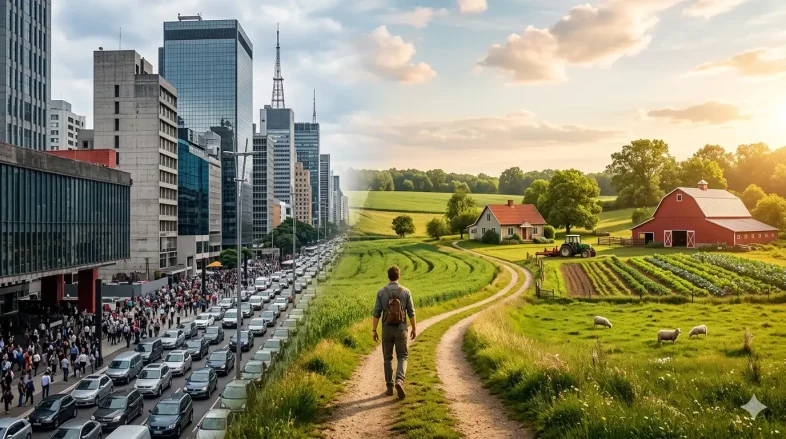
A thought that never leaves the mind is the fear of becoming irrelevant. Every day, an AI tool designs a good website, writes a great article, or make new music. Questioning the skill set and feelings of self-doubt are common. Instead of heading towards self-awareness, self-doubt kicks in. Is this the technology that has taken over? Or is this lacking to match the pace of AI advancements? Should we stop working now? Let’s dig deeper into what we should be doing as professionals in the age of AI. Because getting back to the farm is not the option for most of us.
The Fear Is Real — But So Is the Distortion
Let’s acknowledge something first. The anxiety isn’t imaginary. Jobs are changing. Some have already disappeared. AI is writing copy, generating images, producing code, composing music, and doing it all faster and cheaper than most humans can.
But here’s where the distortion creeps in.
We’re comparing our entire human experience — our doubts, our slow days, our learning curves — against AI’s highlight reel. We see the polished output and forget that AI has no bad days because it has no days at all. It doesn’t grow. It doesn’t reflect. It doesn’t bring anything to the work except what it was trained on.
That comparison was never fair. And building a professional identity around fear of it is a losing strategy.
What AI Has Actually Taken
Be honest about this part. Certain work is gone and it’s not coming back.
The entry-level content job that involved writing generic product descriptions for eight hours a day. The basic SEO article that existed purely to rank for a keyword nobody particularly cared about. The social media post from a template that said nothing specific to nobody in particular.
These weren’t deeply human jobs. They were repetitive, low-judgment tasks that happened to require a human because the technology to automate them didn’t exist yet. Now it does.
Grieving that work makes sense. Rebuilding your identity around it doesn’t.
What AI Has Not Taken — And Cannot
Here is where the conversation needs to land, because this is the part that gets buried under the anxiety.
AI cannot have your specific career. It cannot carry the weight of your particular failures or the clarity that came from them. It cannot replicate the judgment you’ve built through years of working in a specific industry, with specific clients, navigating specific problems nobody put in a training dataset.
Your experience is not a commodity. It never was. It just felt that way when the market rewarded volume over depth.
AI is resetting that equation — in your favor, if you position correctly.
The professionals thriving right now are not the ones who pretended AI wasn’t happening. They’re the ones who got specific. Who narrowed their focus. Who leaned into the parts of their work that require a human mind with a particular history — and stopped competing on the parts that don’t.
What You Should Actually Be Doing
This is not motivational filler. These are practical redirections.
Specialize deeper, not broader. The generalist is the most exposed professional in the AI era. The specialist with genuine depth in a specific niche is the hardest to replace. Pick your lane and own it completely.
Build your own platform. A personal brand with a loyal audience is the most AI-proof career asset available. Nobody can automate the trust you’ve built with people who specifically choose to read you.
Move up the value chain. If you’re producing content, learn strategy. If you’re doing strategy, learn to measure and defend results. The higher the stakes of the decision, the harder it is to delegate to a machine.
Use AI as a tool, not a threat. The professionals who understand AI well enough to direct it effectively are outproducing everyone who doesn’t. That’s not a reason to be afraid. It’s a reason to learn.
The Farm Isn’t the Answer — But Neither Is Denial
There’s a version of this conversation that ends with empty reassurance. Everything will be fine. Humans are irreplaceable. Don’t worry.
That’s not what I’m saying.
Some disruption is real. Some adaptation is mandatory. Some of what we built our careers on will need to be rebuilt on different foundations.
But the professionals who approach that reality with clear eyes — who grieve what’s changed, get honest about what’s required, and move deliberately toward where genuine human value lives — they’re not heading back to the farm.
They’re building something more durable than what existed before AI arrived. The fear of irrelevance is a signal worth listening to. Just don’t let it be the last thought you have before you decide what to do next.