Every conversation about AI and careers eventually arrives at the same question.
What’s left for us?
It’s a fair question. AI writes, designs, codes, composes, analyzes, and strategizes at a speed and scale no individual human can match. The list of tasks it handles competently grows every month. The anxiety that comes with watching that list expand is understandable — and for many professionals, it’s becoming impossible to ignore.
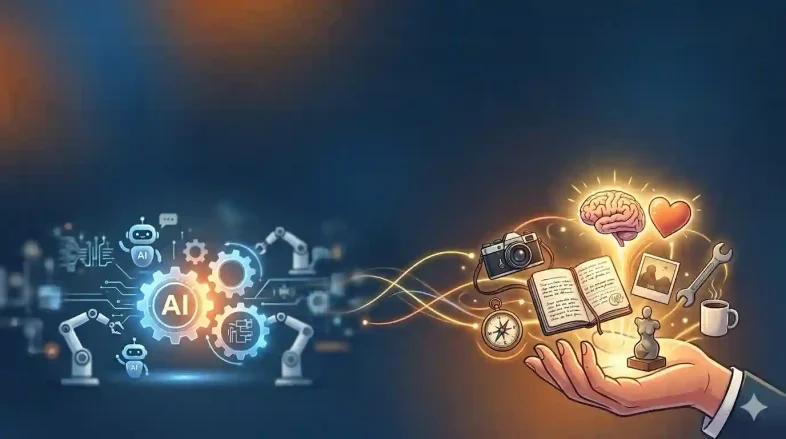
But there is one thing AI cannot do. Not because the technology hasn’t caught up yet. Because it is structurally impossible for it to ever get there.
AI cannot have your specific experience.
What Specific Experience Actually Means
This is not a motivational statement dressed up as strategy. It is a precise, technical observation about what AI is and what it cannot be.
AI learns from existing data. It synthesizes patterns from content that already exists in the world. It produces outputs that are statistically likely given the inputs it receives — which means it is, by definition, a reflection of what has already been said, thought, and written.
Your specific experience is none of those things.
The seven years you spent writing healthcare content — navigating the complexity of medical billing, learning what a physician practice manager actually worries about at 11pm, understanding the difference between how a CFO and a front-desk coordinator read the same piece of information — none of that exists in any training dataset. It exists in you.
The client who pushed back on a strategy you believed in and turned out to be wrong. The campaign that failed in a way nobody predicted and taught you something no case study captures. The judgment call made under pressure that worked — and the one that didn’t. All of it lives exclusively in your history.
AI can produce content about healthcare. It cannot produce content from inside seven years of healthcare experience. The difference between those two things is the difference between information and insight.
Why This Matters More Now Than Ever
Here is the counterintuitive truth about AI’s rise:
The more AI floods the internet with competent, generic, well-structured content — the more rare and valuable genuinely specific, experience-driven content becomes.
When everyone has access to a tool that produces decent writing instantly, decent writing stops being a differentiator. What differentiates is the thing the tool cannot produce — a perspective shaped by specific failures, specific industries, specific relationships, specific years of doing the actual work.
Generic insight is now free. Lived insight is now scarce.
Scarcity determines value. Your specific experience has never been worth more than it is right now — precisely because AI has made everything around it cheaper.
The Problem: Most Professionals Don’t Mine Their Experience
Here is where the opportunity gets wasted.
Most professionals carry years of genuine, specific, valuable experience — and never translate it into anything the world can see or use. It stays locked inside their daily work, informing their decisions privately, never surfacing publicly as content, as positioning, as authority.
The reason is usually one of three things.
They don’t think their experience is remarkable enough to share. It is. The bar for remarkable is not extraordinary. It is specific. A specific observation from a specific industry told through a specific moment is more valuable than a thousand generic insights dressed in polished language.
They don’t know how to translate experience into content. This is a skill — and it is learnable. The formula is simple: here is what happened, here is what I learned from it, here is what it means for you. That structure works every time.
They are waiting until they have more. More experience, more credentials, more certainty that what they know is worth sharing. The waiting is the mistake. What you have right now — today, at this stage of your career — is already more specific and more valuable than anything AI can produce about your field.
How to Turn Your Experience into Your Strongest Asset
This is practical, not philosophical.
Inventory what only you know. Sit with this question seriously: what do I understand about my industry, my craft, or my clients that someone without my specific history would not know? The answers are your content, your positioning, and your competitive advantage simultaneously.
Tell stories, not lessons. Experience lands when it is specific and narrative. Not “here is what I learned about healthcare content” but “here is the moment a client pushed back on a piece I was certain was right — and what happened next changed how I approach every brief.” The story carries the lesson more powerfully than the lesson stated directly.
Publish consistently under your own name. Experience that stays private builds your individual judgment. Experience published publicly builds your reputation, your audience, and your authority. Both matter. Only one compounds into something that generates opportunity.
Stop waiting for permission. Nobody will tell you that your experience is worth sharing. That decision is yours. And the professionals who make it — who claim their specific history as a public asset rather than a private resource — are building something AI cannot replicate, compete with, or replace.
The Bottom Line
AI will continue to get better. The list of tasks it handles will continue to grow. The anxiety about professional relevance is not going away.
But the answer to that anxiety was never to compete with AI on its own terms — speed, volume, breadth. That competition was always unwinnable.
The answer is to go deeper into the territory AI cannot enter.
Your specific experience. Your particular failures and what they taught you. Your hard-won judgment about a specific industry, a specific craft, a specific kind of problem that only years of doing the actual work produces.
That territory is yours alone.
Nobody can automate it. Nobody can replicate it. Nobody can take it from you.
The only question is whether you’re using it.