Something has quietly shifted in how human beings consume information. Not gradually. Not theoretically. It is about attention economy. In ways that are now measurable, documented, and impossible for any serious content creator to ignore.
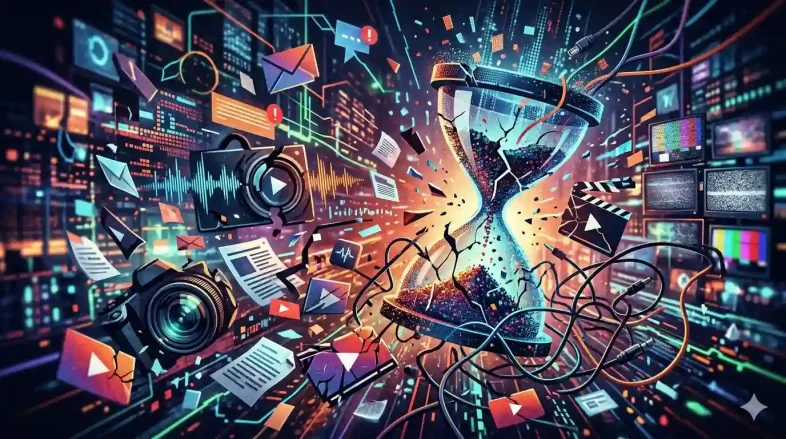
In 2000 the average human attention span was 12 seconds. By 2024-25 screen-based attention had collapsed to just 47 seconds per task — a decline of more than 75% in two decades. A 2026 cross-platform study tracking over 112,000 users across 34 countries confirmed the average human attention span has further declined to 7.97 seconds, with mobile-first users in the 18-34 age bracket averaging just 6.8 seconds before disengaging from any single piece of content. SpeakwiseappAmra & Elma
Seven seconds. That is what you have before a reader decides whether what you’ve made is worth their time.
This is the attention economy in 2026. And for content creators, it changes everything — not just how we write, but why we write, what we write, and what it means to write something worth reading at all.
How We Got Here
The attention economy didn’t collapse overnight. It was engineered to collapse.
People experience information overload because they encounter between 6,000 and 10,000 ads every day, which forces them to evaluate content within two seconds. Every platform, every app, every notification system was designed with one purpose: to capture attention and hold it as long as possible. The business model of the modern internet runs entirely on human attention as a commodity — harvested, packaged, and sold to advertisers at scale. Sci-Tech Today
The result of two decades of this engineering is a population whose cognitive relationship with information has fundamentally changed.
Gen Z averages about 6.5 seconds of focused attention per social media post. TikTok videos under 15 seconds achieve an average completion rate of 76.4%, versus 41.8% for 31-60 second videos. SQ Magazine
The pre-social media era average reading attention span was 2.5 minutes. It is now 47 seconds for digital content. Gitnux
And the cognitive cost goes beyond just shorter attention spans. Cognitive load from digital multitasking overwhelms memory, impairing comprehension by 51%. EEG confirms beta wave activity drops 29% after 45 minutes of scrolling. SQ Magazine
The platforms didn’t just shorten attention. They restructured how the brain processes information entirely.
The Scale of the Problem
The numbers behind attention fragmentation in 2026 are staggering — and for content creators, they tell a story that demands a response.
| Attention Economy Statistic | Data | Source |
|---|---|---|
| Average human attention span in 2026 | 7.97 seconds | Global Digital Attention Research Institute |
| Average screen-based attention per task | 47 seconds | Carnegie Mellon / AutoFaceless, 2026 |
| Gen Z attention per social media post | 6.5 seconds | Multiple sources, 2026 |
| Mobile user attention per content piece | 1.7 seconds | WifiTalents, 2026 |
| Daily ads encountered per person | 6,000 — 10,000 | Sci-Tech Today, 2026 |
| Time to make scroll-or-watch decision | 3 seconds | AutoFaceless, 2026 |
| Focus recovery time after digital interruption | 26.8 minutes | Carnegie Mellon University, 2026 |
| Average time on single task before switching | 9.8 minutes | McKinsey Center for Future of Work, 2026 |
| Comprehension drop from 47-second digital reads vs books | 22% | GitNux, 2026 |
| Lost productivity from interruptions annually | $588 billion | Speakwise / US Knowledge Workforce |
| People experiencing burnout from online communication fatigue | 60% | Speakwise, 2026 |
| YouTube long-form video retention rate | 23.7% | Retention Rabbit, 2026 |
| Viewers leaving YouTube videos within first 60 seconds | 55%+ | Social Rails, 2026 |
| TikTok videos with strong 3-second hooks | 2.2x more views | AutoFaceless, 2026 |
These are not abstract platform metrics. They are the conditions every piece of content you create now exists within.
Why the Attention Economy Is Broken — Not Just Competitive
There is a difference between a competitive market and a broken one.
A competitive market has many players competing for a finite resource — and the best product wins. The attention economy has passed that stage. It is broken in a specific and important way: the attention fragmentation is not a decline but a redistribution. People are spending more total time on screens than ever — six or more hours daily — but distributing that time across hundreds of micro-interactions. Autofaceless
This means the problem isn’t that people have stopped consuming content. They haven’t. They’re consuming more content than at any point in human history. The problem is that the majority of that consumption is shallow, fragmented, and retained at a fraction of previous rates.
A 47-second digital read leads to a 22% comprehension drop versus reading books. People are reading more and understanding less. Consuming more and remembering less. Engaging more and being influenced less. Gitnux
For content creators whose goal is to inform, persuade, or build genuine relationships with readers — this is the broken part. The machinery exists. The eyeballs are there. The depth of connection that makes content actually work has been structurally degraded by the same platforms that deliver the audience.
What This Means for Content Creators Specifically
This is where the conversation shifts from concerning to actionable.
The broken attention economy does not mean content is dead. It means the type of content that works has separated into two categories — and the middle ground between them has largely disappeared.
Category 1: Content designed for the fragmented attention economy Short, fast, visually driven, algorithmically optimized. TikTok reels. LinkedIn carousels. Twitter threads. YouTube Shorts. This content competes on the platform’s terms — capturing attention in three seconds, delivering value in thirty, and disappearing from memory within hours. It builds reach. It rarely builds depth.
Category 2: Content designed to earn sustained attention Long-form articles, newsletters, in-depth podcasts, books. Content that asks something of the reader — time, focus, genuine engagement — and delivers something proportionate in return. Content that earns extended sessions delivers outsized returns precisely because focused attention has become scarce. It builds smaller audiences with dramatically deeper relationships. Autofaceless
The content creators struggling most right now are the ones trying to exist between these two categories. Long enough to require sustained attention. Not deep enough to earn it. That middle ground — the generic 800-word blog post, the standard LinkedIn article, the unremarkable newsletter — is precisely what the broken attention economy has made obsolete.
The Counterintuitive Opportunity
Here is what the data reveals that most commentary on the attention economy misses entirely.
The 47-second average attention span per task does not mean people cannot focus. It means the cost of earning sustained attention has increased dramatically. Autofaceless
Scarcity creates value. In an environment where sustained human attention has become genuinely rare — where most content is consumed in fragments and forgotten within hours — content that actually earns deep engagement is more valuable than it has ever been.
YouTube channels that improve average retention by 10 percentage points see a correlated 25% or more increase in algorithm-driven impressions. The platforms themselves now reward depth of engagement over volume of clicks — because their own algorithms have learned that retained attention is worth more than captured attention. Autofaceless
This is the counterintuitive opportunity in the broken attention economy: the worse the average content gets, the more valuable genuinely good content becomes.
The content creators who understand this are not trying to win the fragmentation game. They are opting out of it entirely — and building something the fragmentation game cannot produce.
What to Do With This Information
Stop creating content for the middle. Generic, moderately useful, broadly targeted content is the most exposed category in the current landscape. It’s too long for the fragmented attention economy and not deep enough to earn sustained attention. Every piece of content should be either optimized for speed and reach or built for depth and relationship. Know which one you’re making before you start.
Lead with your most valuable point. Viewers make scroll-or-watch decisions within 3 seconds. The first sentence of every article, the first line of every LinkedIn post, the first frame of every video — these are not introductions. They are auditions. The value has to be immediately visible or the audience is already gone. Autofaceless
Write for the reader who will actually stay. Not the casual browser. Not the algorithmic impression. The specific person who has a genuine problem your content can solve, who will read to the end because every paragraph earns the next one. Write for that reader and ignore the metrics that measure everyone else.
Build an owned audience. 60% of people experience high stress and burnout due to online communication fatigue. Readers who are exhausted by the attention economy are actively looking for sources they trust enough to return to without being algorithmically pushed. An email list, a newsletter, a community of people who choose to receive your content — these are the most valuable assets a content creator can build in 2026, precisely because they exist outside the broken machinery of the attention economy. Speakwiseapp
Make depth your competitive advantage. The brands and creators winning in the current environment are not the ones posting most frequently. They are the ones whose content is worth the cost of sustained attention. Depth, specificity, genuine expertise, and honest perspective — these are what earn the extended engagement that algorithms and readers now reward equally.
The Bottom Line
The attention economy is broken in a specific way: it has made shallow attention abundant and sustained attention scarce.
For content creators who were building for the middle — good enough to publish, not deep enough to earn genuine engagement — this is a serious problem. That market has largely evaporated.
For content creators willing to choose a lane — either optimizing honestly for speed and reach, or building something deep enough to earn the sustained attention that has become genuinely rare — the opportunity is larger than it has ever been.
The noise has never been louder. The signal has never been more valuable.
Choose to be the signal. Build accordingly. The readers who are exhausted by everything else will find you — and when they do, they will stay.